
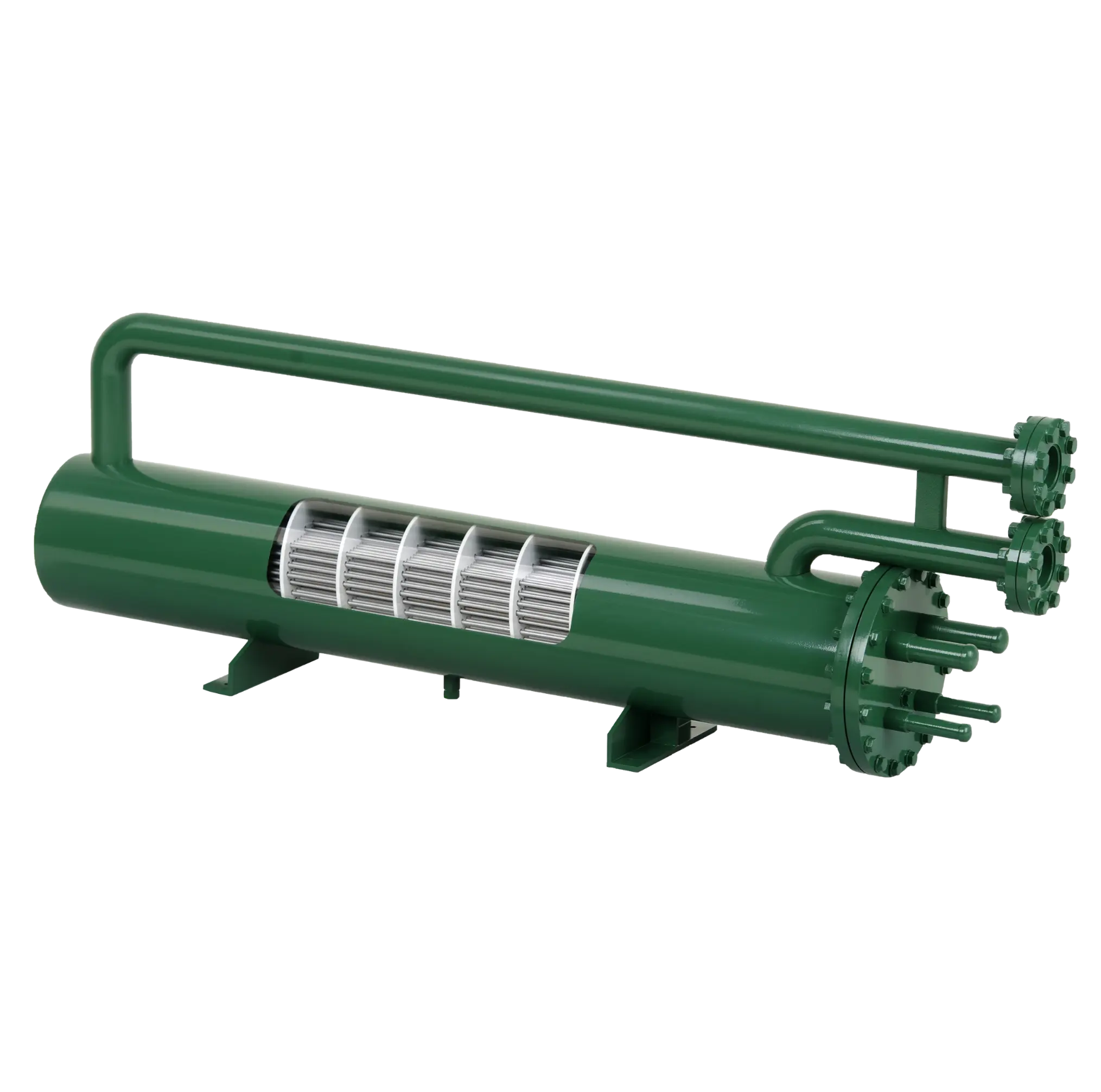
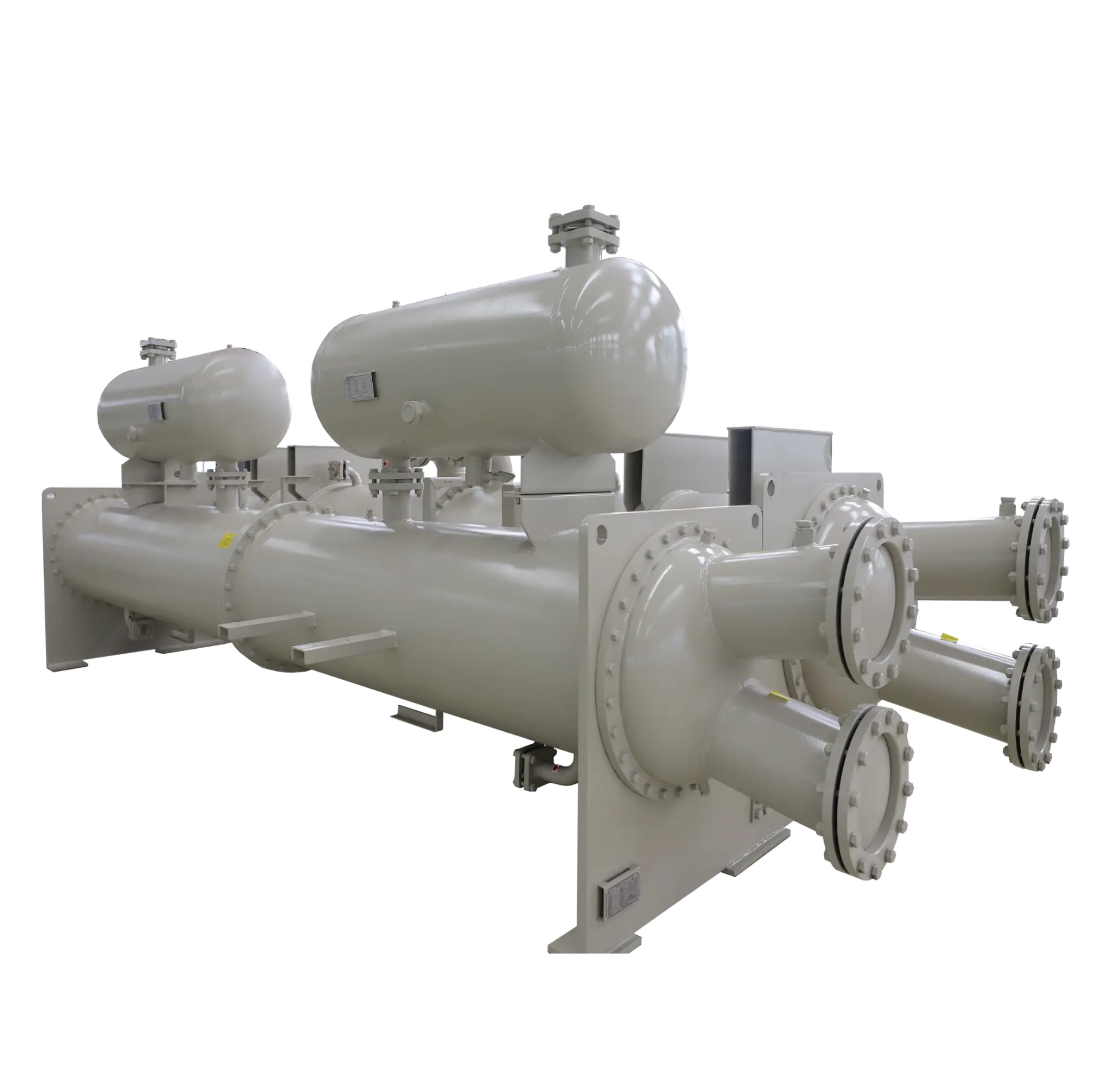
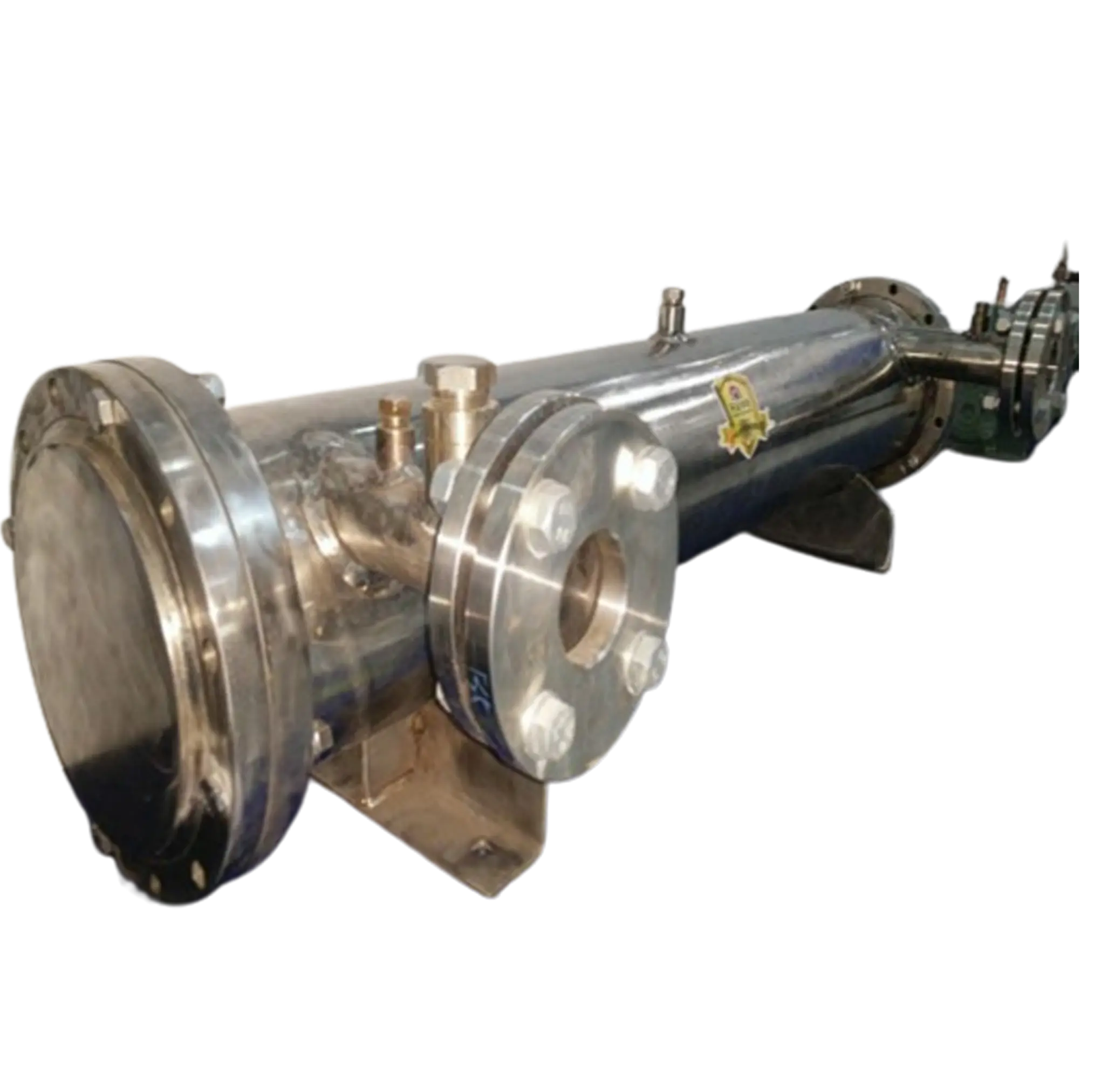
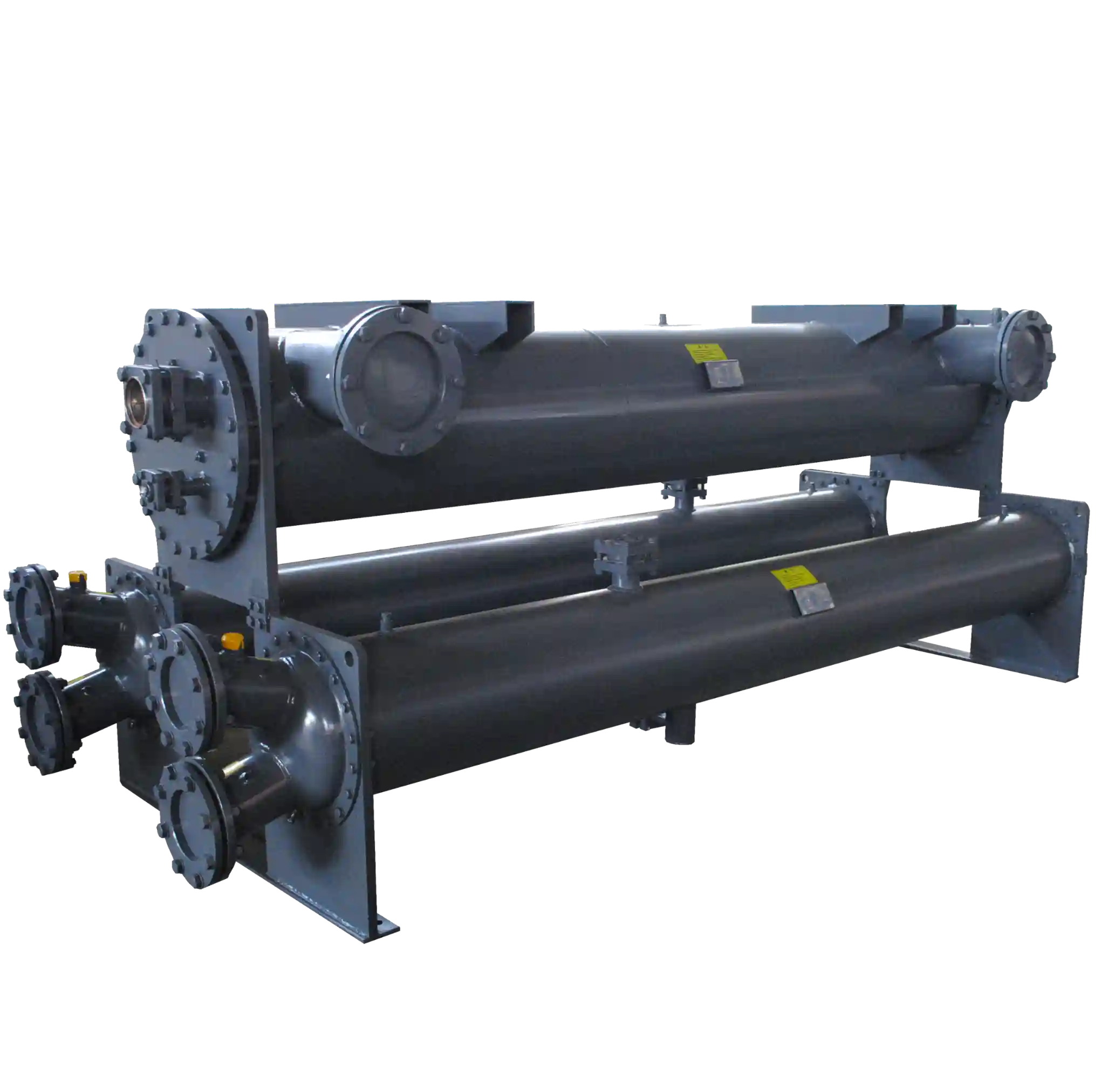
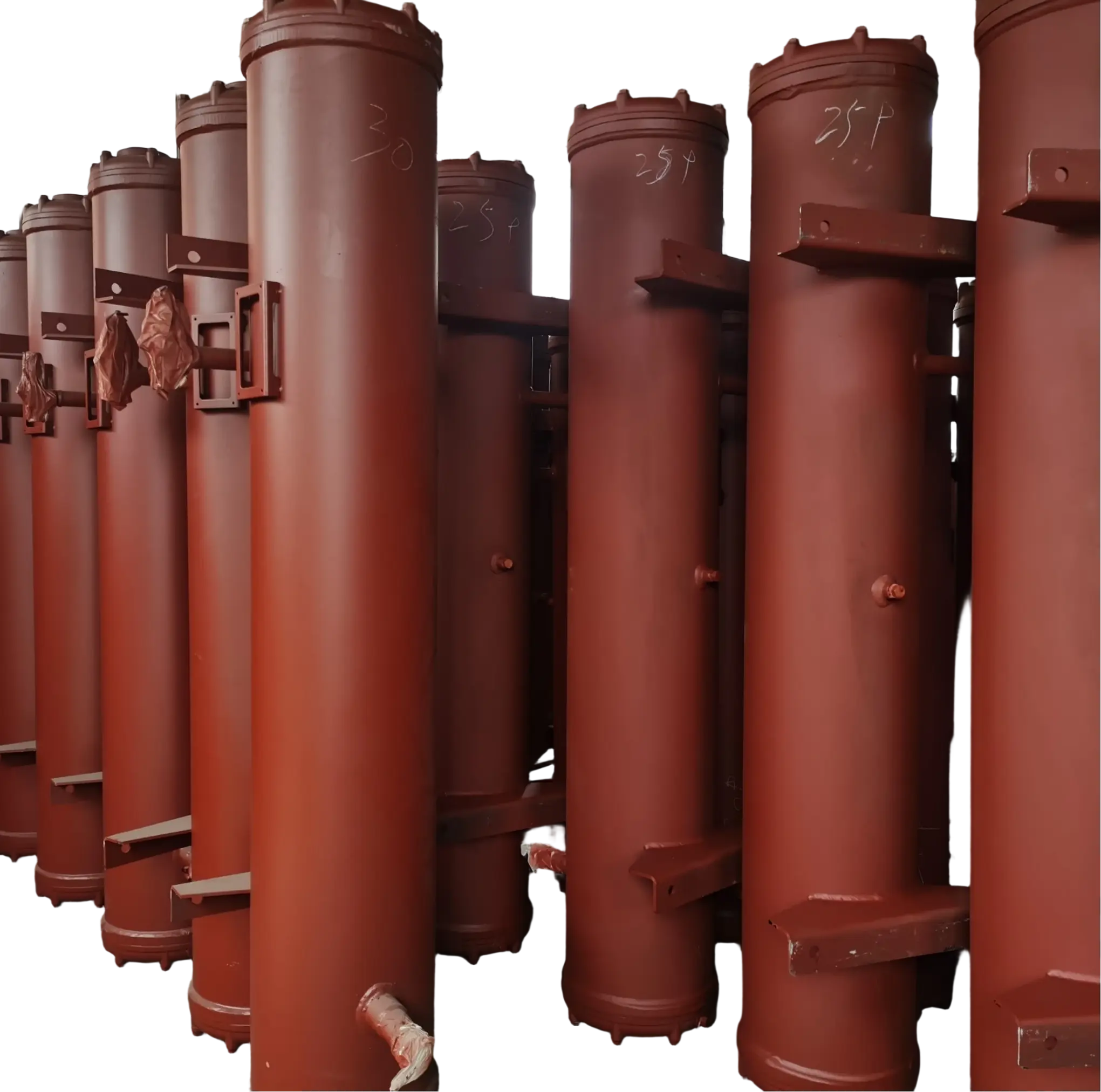
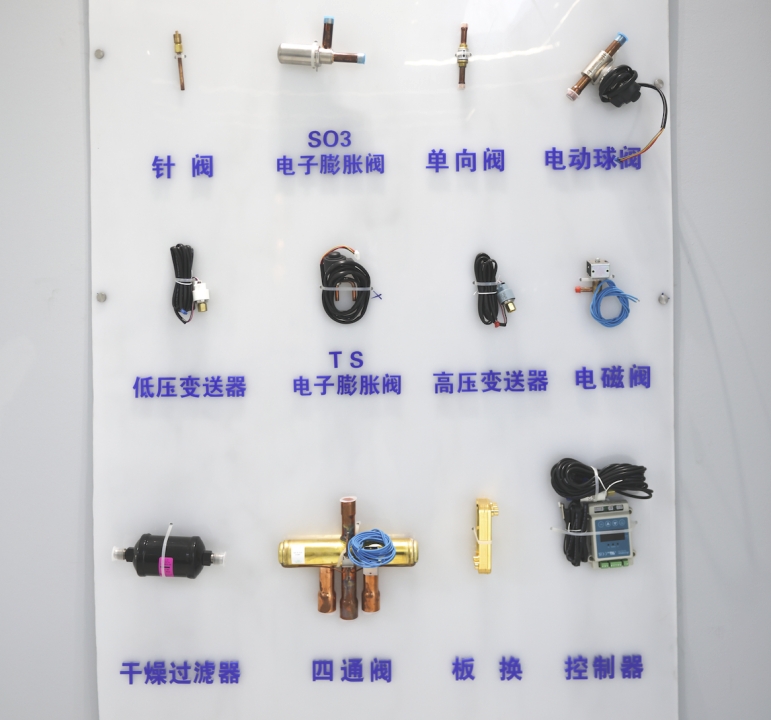
A flooded evaporator works by keeping the evaporator coil, or heat-transfer surface, substantially filled with liquid refrigerant. This allows the refrigerant to boil continuously as it absorbs heat from the fluid or space being cooled. Unlike a conventional dry-expansion evaporator, which controls the supply of refrigerant to maintain superheated vapour at the outlet, a flooded system controls the inventory of refrigerant and the liquid level to ensure that the heat-transfer surface remains wetted. ASHRAE notes that flooded evaporators are particularly useful when a small temperature difference between the refrigerant and the cooled medium is desirable.
Therefore, the operating principle is based on liquid-level control, continuous boiling, vapour-liquid separation, and controlled refrigerant return to the compressor. Depending on the system design, refrigerant circulation can occur naturally through gravity and thermosiphon action, or it can be enhanced by a liquid refrigerant pump. A surge vessel or low-pressure receiver is commonly used to manage the refrigerant level and prevent liquid from reaching the compressor.
What Is a Flooded Evaporator?
A flooded evaporator is a type of refrigeration evaporator in which the heat-transfer surface remains in contact with liquid refrigerant throughout the operating process. Rather than feeding only the amount of refrigerant that can fully evaporate before leaving the coil, the system deliberately maintains a surplus of liquid, enabling boiling to occur across a significant portion of the evaporator’s surface area.
This arrangement is particularly useful in applications where heat transfer performance and a small approach temperature are important. ASHRAE explains that a flooded evaporator can be desirable when only a small temperature difference is required between the refrigerant and the medium being cooled. This is especially advantageous in low-temperature refrigeration.
The term ‘flooded’ does not imply uncontrolled or excessive refrigerant charging. The liquid level is managed intentionally through a float valve, level sensor, or a similar control mechanism. The system therefore has a defined operating inventory and a controlled liquid-vapour interface.
In many industrial refrigeration systems, the evaporator is connected to a surge drum or low-pressure vessel. Liquid refrigerant enters the evaporator, absorbs heat, and boils; the resulting liquid-vapour mixture then returns to the vessel. The vapour is separated and directed towards the compressor suction line, while the liquid remains available for continued circulation.
How Does a Flooded Evaporator Work Step by Step?
The simplest way to understand a flooded evaporator is to follow the refrigerant through the system rather than looking at the evaporator as an isolated heat exchanger.
First, high-pressure liquid refrigerant leaves the condenser or receiver and passes through a refrigerant control device. Depending on the system configuration, this may involve a high-side float, low-side float, solenoid valve, hand expansion valve, or another level-control arrangement. The purpose is not primarily to create a particular outlet superheat, as it would be in a typical DX system, but to provide the evaporator with enough refrigerant to maintain the required liquid level. ASHRAE describes low-side float control as a common method in flooded systems: when the low-side liquid level falls, the float opens the valve and allows more liquid refrigerant into the evaporator or surge drum.
Second, liquid refrigerant occupies the evaporator heat-transfer surface. Heat from the water, brine, air, process fluid, or another medium passes through the heat-transfer wall into the refrigerant. Because the refrigerant is maintained at its saturation condition at the evaporating pressure, this heat causes the liquid refrigerant to boil.
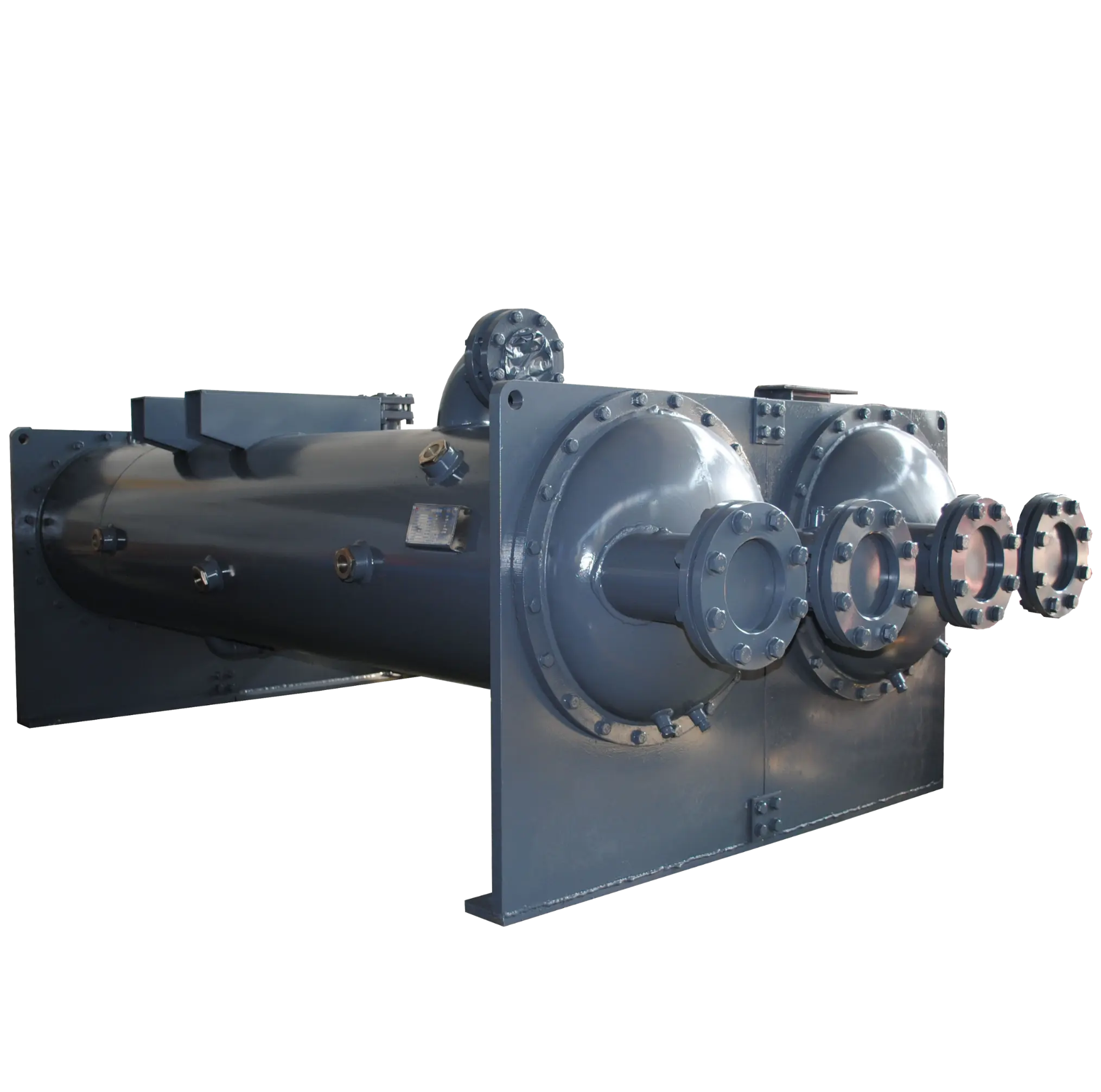
Third, vapor bubbles form and rise through the liquid. As additional heat enters the evaporator, more refrigerant changes from liquid to vapor. In a shell-and-tube flooded cooler, for example, the refrigerant may surround tubes carrying water or brine, with the warmer process fluid transferring heat through the tube walls into the surrounding refrigerant. ASHRAE describes this arrangement as refrigerant vaporizing on the outside of tubes submerged in liquid refrigerant.
Fourth, the vapor-liquid mixture reaches a separation region or surge vessel. The vapor must be separated from liquid droplets before it enters the compressor suction line. Baffles, dropout spaces, separators, or appropriately designed vessels can reduce liquid carryover. ASHRAE specifically notes that vapor separation is necessary in flooded coolers because boiling can generate refrigerant mist that could otherwise travel toward the compressor.
Finally, refrigerant vapor travels to the compressor. The compressor removes the low-pressure vapor from the evaporating side and raises its pressure and temperature, after which the refrigerant continues through the condenser and the rest of the refrigeration cycle.
Why Does a Flooded Evaporator Keep Liquid Refrigerant in the Coil?
The central engineering reason is heat-transfer utilization. A heat-transfer surface covered with boiling liquid refrigerant can remain active across a large part of the evaporator, whereas a dry-expansion coil normally progresses from a liquid-rich region toward increasingly vapor-rich flow and finally superheated vapor.
Maintaining liquid refrigerant around the heat-transfer surface provides a relatively stable boiling condition. The refrigerant temperature is closely related to its saturation pressure, so the evaporator can operate with a relatively small temperature difference between the refrigerant and the medium being cooled. This characteristic is one reason flooded evaporators are widely considered for low-temperature and industrial refrigeration applications.
However, maintaining liquid coverage does not mean that more refrigerant is always better. Excessive liquid inventory can increase refrigerant charge and create control or compressor-protection challenges. The objective is to maintain the appropriate operating level and circulation rate while ensuring that vapor can leave the evaporator without significant liquid entrainment.
| Operating feature | Flooded evaporator | Typical dry-expansion evaporator |
| Refrigerant condition in evaporator | Predominantly liquid with active boiling | Liquid-vapor mixture progressing toward vapor |
| Main control principle | Refrigerant level/inventory | Outlet superheat |
| Heat-transfer surface | Kept substantially wetted | Gradually dries toward outlet |
| Outlet condition | Vapor separated from liquid | Normally superheated vapor |
| Typical control device | Float, level sensor, pump or related control | TXV, EEV or similar metering device |
| Refrigerant charge | Generally higher | Generally lower |
| Compressor protection | Requires effective liquid separation | Superheat control helps limit liquid return |
| Common advantage | High heat-transfer effectiveness and small temperature difference | Simpler refrigerant control and lower charge |
What Controls the Refrigerant Level in a Flooded Evaporator?
One of the defining characteristics of a flooded evaporator is liquid-level control. The control system must continuously balance the amount of refrigerant entering the low-pressure side with the amount of refrigerant being boiled and removed as vapour.
One established approach is a low-side float valve. When the liquid level in the evaporator or surge vessel falls, the float mechanism opens the refrigerant inlet to allow more liquid to enter. When the level rises, the valve closes or throttles the feed. ASHRAE describes this arrangement as a low-pressure-side float system, noting that the float can be installed directly in the evaporator or surge drum, or in an external chamber connected by equalising lines.
A high-side float control can also be used. In this configuration, the liquid level on the high side influences the supply of refrigerant to the low-pressure part of the system. Other systems use electronic level sensors, capacitance probes, solenoid valves, or PLC-based controls. ASHRAE notes that capacitance probes can provide continuous liquid-level monitoring and transmit the resulting signal to a control system.
The important distinction is that the control objective is to maintain the refrigerant inventory within the evaporator or associated vessel rather than to maintain a predetermined superheat at the evaporator outlet. ASHRAE also states that thermostatic expansion valves are rarely used for flooded evaporators, as the required superheat is inconsistent and makes it difficult to keep the evaporator flooded.
How Does Refrigerant Circulate Through a Flooded Evaporator?
There are two principal circulation approaches: gravity/thermosiphon circulation and forced circulation using a refrigerant pump.
In a gravity or thermosiphon system, the density difference between liquid refrigerant and the vapor-liquid mixture provides the driving force for circulation. Refrigerant enters the evaporator, absorbs heat and boils, and the resulting mixture moves back toward the surge vessel. The vapor separates from the liquid, while the liquid remains available to circulate through the evaporator. ASHRAE specifically identifies gravity and thermosiphon effects as the basis for natural circulation in flooded evaporator arrangements.
Forced circulation uses a liquid refrigerant pump to establish a more positive and predictable flow through the evaporator. This can be advantageous where a higher circulation rate is required or where the physical arrangement of the system does not provide sufficient natural circulation. ASHRAE describes the liquid refrigerant pump as a means of obtaining a higher and more positive circulation rate.
The difference can be summarized as follows:
| Circulation method | How it works | Typical benefit | Main consideration |
| Gravity circulation | Density differences drive refrigerant movement | Simple and reliable arrangement | Requires suitable elevation and piping |
| Thermosiphon circulation | Boiling-induced density difference drives flow | Good passive circulation | System geometry is important |
| Pumped circulation | Refrigerant pump forces liquid through evaporator | Higher and more controllable circulation rate | Adds pump, controls and maintenance requirements |
What Happens to the Refrigerant After It Boils?
Just because something is boiling does not mean that every molecule of refrigerant immediately becomes vapour. The evaporator outlet may contain a mixture of liquid and vapour, especially in a flooded arrangement. Therefore, this mixture must be handled carefully before the vapour reaches the compressor.
The surge tank or low-pressure receiver provides space for this separation to occur. The liquid refrigerant remains in the vessel while the vapour moves towards the compressor suction line. A baffle or other internal separation feature can reduce foam and liquid entrainment. ASHRAE specifically recommends separation arrangements in flooded systems to prevent liquid entering the suction line.
It is important to understand the difference between a flooded system and simply assuming that liquid refrigerant returns to the compressor. The purpose of the flooded arrangement is to supply the evaporator with liquid and prevent uncontrolled liquid refrigerant from entering the compressor. Liquid carryover can cause severe mechanical and operational problems, so the suction path must be designed to deliver vapour and provide appropriate compressor protection.
Oil management is another consideration. Refrigeration oil circulates with the refrigerant, and a flooded evaporator can create conditions in which oil accumulates on the low-pressure side. ASHRAE therefore discusses dedicated oil-return arrangements for flooded systems, including methods that return an oil-rich refrigerant stream to the compressor circuit.
What Are the Advantages of a Flooded Evaporator?
The most important advantage is the effective use of the heat-transfer surface. Since the liquid refrigerant is maintained across a large part of the evaporator, a significant proportion of the available surface area is able to participate in the process of boiling heat transfer, rather than becoming progressively superheated towards the outlet.
A second advantage is the ability to operate with a small temperature difference between the refrigerant and the cooled medium. This is particularly valuable where accurate low-temperature control is required by the process or where minimising the temperature approach can improve system performance. ASHRAE explicitly identifies the small temperature differential as a key reason for selecting flooded evaporators.
A third benefit is that flooded systems work particularly well with large industrial heat exchangers and centralised refrigeration systems. Flooded shell-and-tube coolers, for instance, are often used alongside screw or centrifugal compressors to cool water, glycol mixtures or brine.
The trade-offs are equally important. Flooded systems generally require a greater refrigerant charge and more sophisticated liquid-level and oil management systems than basic DX systems. Compressor protection, refrigerant separation, vessel sizing, equalising lines, and control stability must all be considered during system design.
Flooded Evaporator vs. DX Evaporator: What Is the Difference?
The fundamental difference lies in what the system is trying to control. A dry-expansion, or DX, evaporator typically controls the flow of refrigerant so that it is almost entirely evaporated by the time it reaches the outlet, leaving behind superheated vapour. In contrast, a flooded evaporator maintains a liquid refrigerant inventory, ensuring the evaporator remains wetted and the vapour is separated elsewhere in the system.
This difference has an impact on the entire refrigeration architecture. While a DX system can use a thermostatic or electronic expansion valve as its principal metering device, a flooded system depends on a float valve and surge vessel. The compressor suction line in a flooded system also requires particular attention to vapour-liquid separation.
Neither approach is universally suitable for every refrigeration installation. The most appropriate configuration depends on factors such as capacity, refrigerant type, temperature level, heat exchanger design, compressor type, refrigerant charge considerations, control requirements, and the desired operating envelope.
What Problems Can Occur in a Flooded Evaporator?
A flooded evaporator can lose performance when the refrigerant level, circulation rate, separation efficiency, or oil return deviates from the intended operating condition. Low liquid level can expose part of the heat-transfer surface and reduce evaporator capacity, while excessive liquid level can increase the risk of liquid carryover and interfere with stable operation.
Poor level sensing is another potential issue. Boiling refrigerant is not a perfectly calm liquid, so a level sensor can experience fluctuations caused by bubbles, foam, pressure variations, or oil. ASHRAE specifically warns that the boiling environment can produce false level readings and discusses the use of appropriate low-side sensing arrangements.
Oil accumulation can also reduce effective heat-transfer performance. If oil forms a film on heat-transfer surfaces, the additional thermal resistance can interfere with refrigerant boiling and reduce capacity. At the same time, insufficient oil return can eventually affect compressor lubrication.
Another common engineering concern is floodback during startup or shutdown. ASHRAE notes that when a low-side float valve is used, refrigerant feed may need to be shut off when the compressor or suction valve stops; otherwise, excess refrigerant can accumulate and potentially return as liquid when the system restarts.
Where Are Flooded Evaporators Commonly Used?
Flooded evaporators are particularly important in industrial refrigeration, process cooling and large chilled-fluid systems. They are also used in low-temperature applications, food processing, cold storage and chemical processing, as well as in other installations where heat-transfer performance and stable low-temperature operation are important. ASHRAE’s Refrigeration Handbook covers flooded arrangements across a range of applications, including food processing, industrial refrigeration, chemical plants, and other specialised refrigeration systems.
Large shell-and-tube flooded coolers are a notable example. In these systems, water, brine, or glycol flows through the tubes, with the refrigerant surrounding the tubes and boiling outside them. The large heat-transfer surface area and the ability to control the level of the refrigerant make this configuration attractive for high-capacity applications.
When evaluating a flooded evaporator for an industrial project, therefore, engineers should look beyond nominal evaporator capacity. The refrigerant type, operating pressure, liquid level, circulation method, surge vessel volume, compressor characteristics, oil return, separation efficiency, control response, and refrigerant charge should all be considered together. It is best to understand a flooded evaporator as part of an integrated refrigeration circuit rather than merely as an alternative coil design.
Flooded Evaporator FAQs
- What is a flooded evaporator?
A flooded evaporator is a refrigeration heat exchanger that operates with its heat-transfer surface substantially covered by liquid refrigerant. The refrigerant boils as it absorbs heat, while a separate control and separation system manages liquid level and vapor return.
- How does a flooded evaporator control refrigerant flow?
It commonly uses a float valve or liquid-level sensing system to maintain the required refrigerant level. Some designs also use solenoid valves, electronic level controls, or a refrigerant circulation pump.
- What is the difference between a flooded evaporator and a DX evaporator?
A flooded evaporator maintains liquid refrigerant in the heat exchanger, while a DX evaporator meters refrigerant so that it is largely evaporated before leaving the coil. DX systems typically control outlet superheat, whereas flooded systems primarily control refrigerant level and circulation.
- Why is a surge tank used with a flooded evaporator?
A surge tank provides refrigerant inventory and creates a space where liquid and vapor can separate. It helps supply liquid back to the evaporator while directing vapor toward the compressor suction line.
- Can a flooded evaporator use a refrigerant pump?
Yes. Pumped flooded systems use a liquid refrigerant pump to provide a more positive circulation rate through the evaporator. ASHRAE identifies pump circulation as an option when a higher circulation rate is desirable.
- What are the main disadvantages of a flooded evaporator?
Flooded systems generally require a larger refrigerant charge and more attention to liquid-level control, vapor separation, oil return, and compressor protection. Their additional components can make the system more complex than a conventional DX arrangement.
Conclusion
The purpose of a flooded evaporator is to maintain a liquid refrigerant across its heat-transfer surface, enabling efficient boiling as heat enters the refrigeration system. The level of refrigerant is controlled using float or electronic methods. Circulation occurs via gravity, thermosiphon action, or a pump. The resulting vapour-liquid mixture is separated before the vapour travels to the compressor.
The real engineering value of a flooded evaporator does not simply lie in the fact that it contains ‘more liquid’. It is advantageous because it maintains effective refrigerant contact with the heat-transfer surface, allowing the system to operate with a relatively small temperature difference. However, successful operation also depends on accurate liquid-level management, proper vapour separation, reliable oil return, and protection against liquid floodback. It is these factors that explain why flooded evaporators remain an important configuration for large-capacity and industrial refrigeration systems.